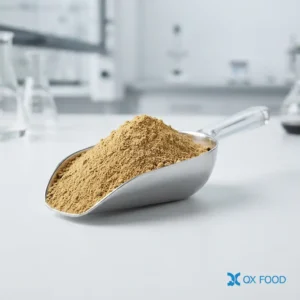

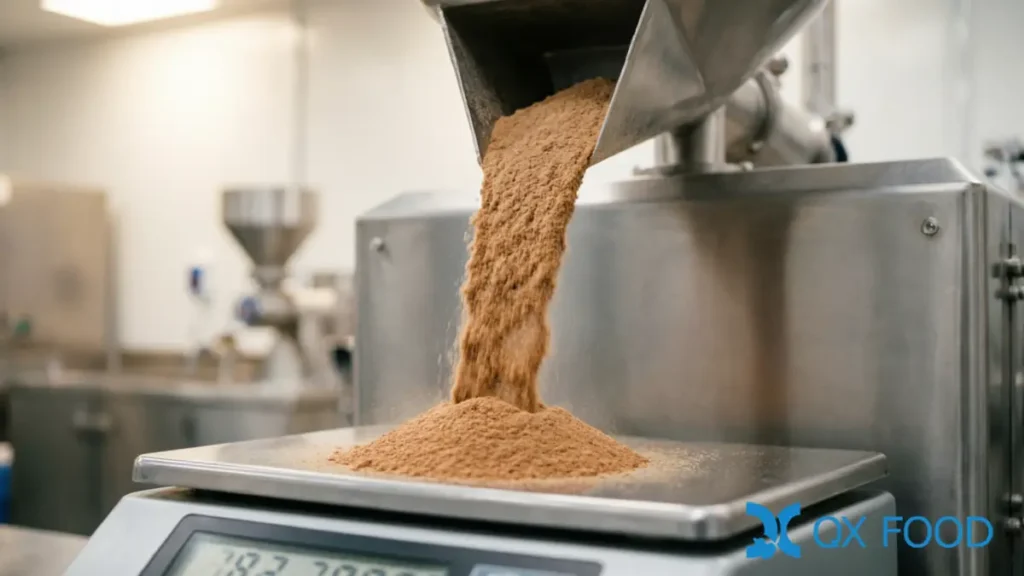
Economical soy HVP powder HVP-FSBE is the value-tier spray-dried hydrolyzed soy protein in the Qianxuan powder HVP range — positioned for formulators who need reliable savory performance at the lowest achievable per-kilogram product cost. With total nitrogen at 2.7 g/100g, sodium chloride at 45.0 g/100g, and moisture at 7.0 g/100g, this cost effective soy HVP powder delivers functional umami and Maillard reactivity at a nitrogen level appropriate for applications where HVP supports the flavor system rather than leading it. Its defining sensory features — rich bean aroma, full-bodied character, and good umami taste — provide a quality savory experience despite the economy nitrogen tier, while its light tea-colored appearance makes this economical soy HVP powder visually unobtrusive in formulations where a darker brownish-red powder would be noticeable. ISO 9001 and ISO 22000 certified with HACCP and Halal, this product is built for bulk procurement in cost-sensitive seasoning, bouillon, and foodservice base production.
What “Economical” Means in HVP Powder: Cost vs Nitrogen
HVP powder pricing correlates directly with nitrogen content: the deeper the hydrolysis, the higher the nitrogen extraction, the higher the production cost per kilogram. This economical soy HVP powder at 2.7 g/100g total nitrogen occupies the value tier — nitrogen that is fully functional for standard savory applications without the premium cost of deeper hydrolysis. A standard-grade powder at 3.2 N delivers approximately 18% more nitrogen per gram. A premium high-nitrogen powder at 4.13 N delivers approximately 53% more. The question for the procurement manager is not “which has more nitrogen?” but “does my application require premium nitrogen, or does 2.7 N at a meaningfully lower per-kilo cost meet my cost-performance targets?”
This cost effective soy HVP powder is the right answer when the HVP is a supporting player in a multi-ingredient seasoning system — contributing amino acids, rounding out umami, and participating in Maillard browning — but is not the primary nitrogen source in the formulation. In chicken bouillon where meat extract or yeast extract carries the main flavor load, in compound seasoning blends where multiple ingredients share the savory responsibility, and in foodservice bases where consistent, adequate umami at the right price point is the objective, the economy tier is the correct procurement choice. For applications where HVP is the sole or dominant nitrogen source — concentrated bouillon, premium seasonings, high-intensity snack coatings — the nitrogen premium of higher-tier powders (FSA or FSAH) justifies the higher per-kilo cost. For the complete nitrogen-tier comparison, see the HVP solutions guide.
Light Tea Color: Visual Economy Without Quality Compromise
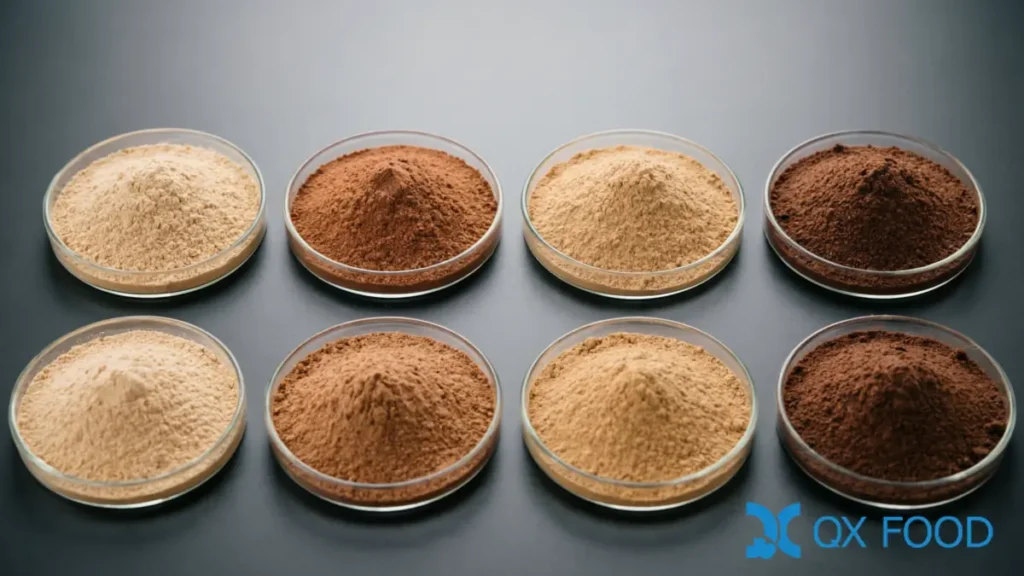
Many economy HVP powders are brownish-red — the deeper color resulting from the standard hydrolysis process. This economical soy HVP powder at FSBE deviates from that pattern: it is light tea-colored, visibly lighter than the typical brownish-red HVP powder. This is not an incidental feature — it is a production characteristic that gives this light tea color HVP powder a visual advantage in light-colored formulations where a dark brownish-red powder would introduce unwanted tinting, even at the economy price point.
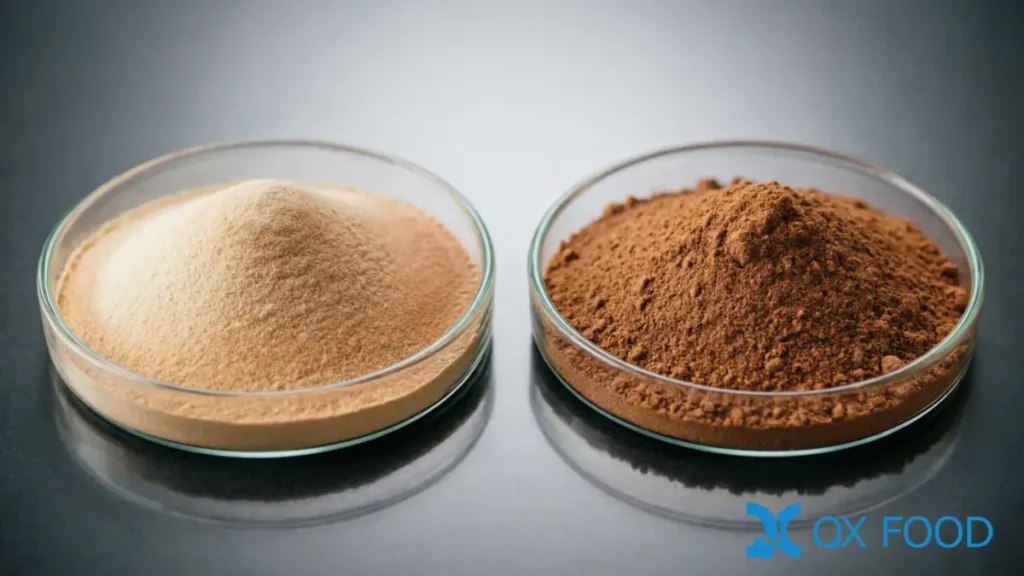
The tea color is subtle but perceptible — it reads as a warm off-white to pale brown in dry powder form, rather than the deeper reddish-brown of standard HVP. For cream-based soup powders, white sauce seasonings, delicately colored bouillon granules, and light-colored compound seasoning blends, this cost effective soy HVP powder contributes flavor without the color penalty that typically accompanies economy-tier HVP products. Combine with FSB EU-compliant light-color HVP for applications where both economy pricing and EU documentation are required.
The sensory profile of this economical soy HVP powder — rich bean aroma, full-bodied character, good umami taste — reinforces the value proposition: these are not “economy-quality” sensory attributes. The bean aroma is rich, not thin. The body is full, not watery. The umami is good, not barely-there. The economy designation reflects nitrogen level and cost, not sensory quality. For formulators evaluating cost-optimized HVP options who have previously rejected economy-tier products due to weak flavor performance, FSBE may warrant a second look.
Technical Specifications: Economical Light Tea-Colored HVP Powder
| Parameter | Specification | Formulator’s Note |
|---|---|---|
| Product SKU | HVP-FSBE | Economy tier — lowest cost per kg among soy powder HVP |
| Physical State | Powder | Free-flowing; dry blending, sachet filling |
| Appearance | Light tea-colored powder | Lighter than standard brownish-red; visually unobtrusive |
| Flavor | Rich bean aroma, full-bodied, good umami taste | Sensory quality above what economy tier implies |
| Total Nitrogen | 2.7 g/100g measured | Functional for supporting-role HVP applications |
| Sodium Chloride | ≤45.0 g/100g measured | Higher salt from hydrolysis — account for in sodium target |
| Moisture | ≤7.0 g/100g measured | Adequate for dry blending stability |
| 3-MCPD | ≤0.4 mg/kg (product notes) | Below Codex ceiling; export-compliant |
| Certification | ISO 9001, ISO 22000, HACCP, Halal | Full certification suite at economy pricing |
| Process | Acid Hydrolysis, Spray Drying | Standard controlled production |
| Suggested Usage | 2-10% of formulation | Calibrate for target umami, salt, and cost |
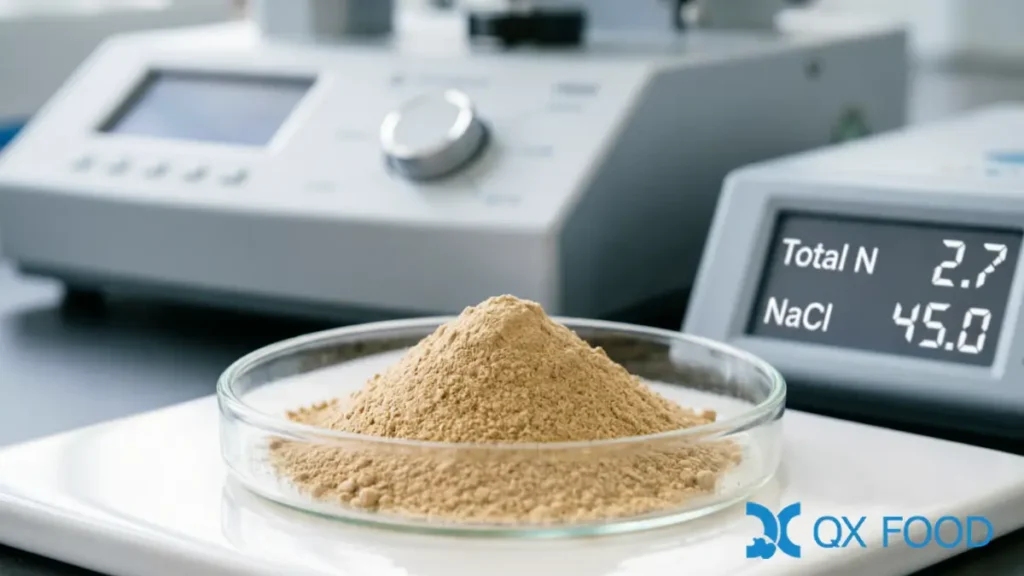
The 2.7 g/100g total nitrogen of this economical soy HVP powder represents the entry nitrogen tier for soy HVP powder — approximately 16% below standard FSA at 3.2 N, approximately 35% below premium FSAH at 4.13 N, but fully functional for the supporting-role applications where nitrogen maximization is not the formulation constraint. The higher NaCl at 45.0 g/100g — the highest among soy powder HVP SKUs — is an inherent characteristic of the specific hydrolysis process used for this product and must be factored into the total formulation sodium calculation. The full certification suite (ISO 9001, ISO 22000, HACCP, Halal) at the economy price point is a procurement advantage — economy pricing does not entail reduced certification coverage. The product aligns with EFSA and Codex Alimentarius acid-HVP standards. For buyers evaluating nitrogen cost-per-gram across the powder HVP range, compare with FSA standard and full tier analysis.
Applications Where Economy Powder HVP Delivers Best Cost-to-Performance
① Budget Compound Seasoning Blends (2-10%)
In multi-component dry seasoning blends where HVP is one of several savory contributors alongside salt, MSG, spices, and dehydrated vegetables — this economical soy HVP powder provides the amino acid backbone at the lowest per-kilo cost. The light tea color blends unobtrusively into the seasoning mix without the visual darkening that some economy HVP powders introduce. For manufacturers producing private-label seasoning blends for retail where ingredient cost is a primary margin driver, FSBE at 2.7 N delivers functional performance without the nitrogen premium that would squeeze product margins. Compare with FSC seasoning grade for similar cost-performance in seasoning applications.
② Foodservice Bouillon and Catering Bases (2-10%)
Foodservice seasoning bases operate on cost-efficiency at scale — a foodservice operator buying bulk bouillon paste evaluates price per kilogram against flavor adequacy, not against premium nitrogen specifications. This cost effective soy HVP powder at 45.0 NaCl provides both umami contribution and salt in a single ingredient — reducing the number of inputs in the foodservice base formulation and simplifying the procurement bill of materials. The light tea color is an advantage in bulk foodservice bouillon where visual consistency across large batches is expected. For premium foodservice applications requiring higher nitrogen, see FSA standard powder.
③ Processed Meat and Savory Products (2-10%)
In sausage, meatball, and processed meat formulations where HVP contributes to flavor and water binding, the 2.7 N of this economical soy HVP powder is sufficient for the supporting role it plays alongside meat protein, fat, and other functional ingredients. The higher salt (45.0 g/100g) contributes to the overall sodium content — a consideration for sodium-reduced product lines where the salt from HVP must be balanced against reduced added salt in the primary formulation.
Why Cost-Conscious Buyers Select FSBE Over Higher-Tier Powders
- Lowest per-kilo cost for functional umami. At a nitrogen level appropriate for supporting-role HVP applications, this economical soy HVP powder delivers adequate savory performance at the lowest achievable product cost — freeing budget for flavor-critical ingredients like meat extract, yeast extract, or premium spice components.
- Light tea color at the economy tier. Many economy powders are dark brownish-red. This light tea color HVP powder preserves visual neutrality in light-colored formulations — a color advantage typically associated with higher-tier products, available at the economy price point.
- Full certification without premium pricing. ISO 9001, ISO 22000, HACCP, Halal — the same certification suite as premium powder HVP products, included with this cost effective soy HVP powder without a certification surcharge.
- Rich sensory profile despite economy tier. Rich bean aroma, full-bodied character, good umami taste — sensory descriptors that typically describe mid-tier or premium HVP, not economy grades. The trade-off is nitrogen level, not flavor quality.
- Flexible packaging and supply. 100 g and 1 kg foil bags for trials, 10 kg and 20 kg cartons for production, 25 kg fiber drums for bulk. Custom packaging available. MOQ 1 MT, 1 kg samples. Contact us for volume pricing on multi-ton procurement.
Storage, Handling & Compliance
Powder Storage
- Store sealed below 25°C, humidity below 60%
- Reseal tightly after opening — hygroscopic powder
- Shelf life: 12 months under recommended conditions
Compliance
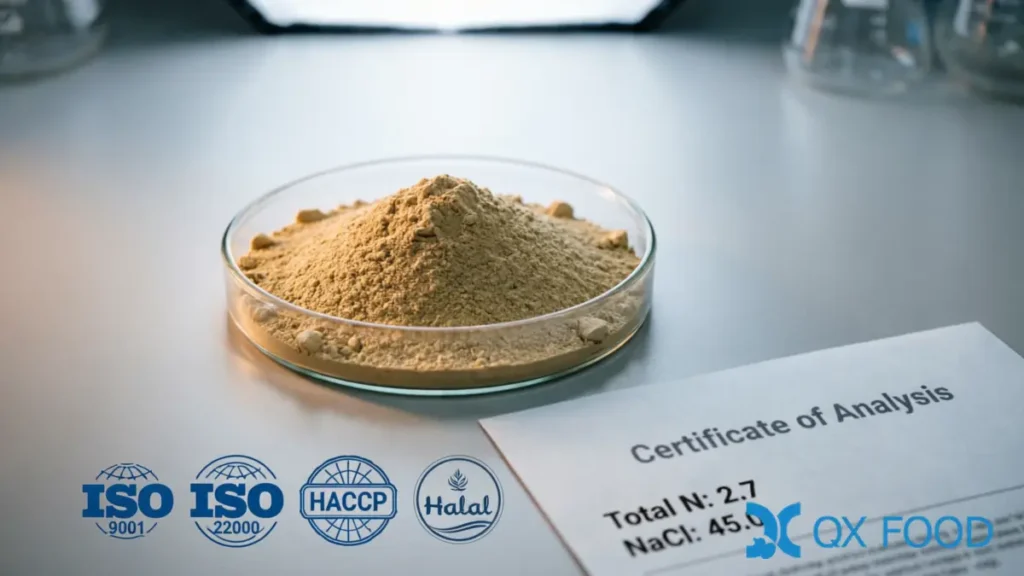
ISO 9001, ISO 22000, HACCP, Halal certified. GB 2760. 3-MCPD ≤0.4 mg/kg — below EFSA and Codex standards. Allergen: Soy.
Frequently Asked Questions
How does FSBE differ from standard FSA powder?
This economical soy HVP powder delivers 2.7 N (FSA = 3.2 N, approximately 18% more nitrogen). NaCl is 45.0 g/100g (FSA = 38.1). Color is light tea (FSA = brownish-red). Flavor is rich bean aroma with full body and good umami (FSA = standard reference soy flavor). FSBE is the economy tier for cost-sensitive applications; FSA is the standard reference grade. Choose FSBE when HVP plays a supporting role in a multi-ingredient system; choose FSA when HVP is a primary flavor contributor or when higher nitrogen per gram is needed.
Is the higher salt content a problem for formulation?
NaCl at 45.0 g/100g is the highest among soy powder HVP SKUs — meaning more of your total product sodium comes from the HVP input. For formulations where salt target is already tight, this cost effective soy HVP powder may require reducing added salt elsewhere to stay within sodium targets. For lower-salt economy alternatives, consider FSA at 38.1 NaCl — though at a higher per-kilo product cost.
What does “good umami taste” mean at this nitrogen level?
Total N 2.7 is the economy tier — but the sensory profile of this economical soy HVP powder (rich bean aroma, full-bodied, good umami) suggests that nitrogen level alone does not fully determine flavor quality. The product description specifically calls out the flavor character — rich, full, good — indicating that the sensory target was achieved despite modest nitrogen. For formulators who have previously rejected economy HVP products due to thin or weak flavor, FSBE may deliver better-than-expected sensory performance at the economy price point.
Can light tea-colored HVP powder be used in cream-based formulations?
Yes. This light tea color HVP powder is visibly lighter than typical brownish-red HVP — reading as warm off-white to pale brown in dry form — making it suitable for cream soups, white sauce bases, and delicately colored seasoning blends. For even lighter color with premium nitrogen, see FSB EU-compliant light color.
What certifications, MOQ, and packaging apply?
ISO 9001, ISO 22000, HACCP, Halal. 100 g/1 kg foil bags, 10/20 kg cartons, 25 kg drums. MOQ 1 MT, 1 kg samples. Contact us.
Explore Economy, Standard, and Premium HVP Powder Options
- HVP-FSA Standard Soy HVP Powder — Reference grade at 3.2 N
- HVP-FSB Light Color EU HVP Powder — Light color, 4.2N, EU-compliant
- HVP-FSAH Premium High-Nitrogen Powder — Premium tier at 4.13 N
- HVP-FSC Seasoning Grade Powder — Seasoning-optimized soy powder
- MF-01 Specialty Flavor Powder — Rich bean aroma for flavor systems
- HVP-FYA Corn HVP Powder — Soy-free corn alternative
For the full product selection and nitrogen-tier analysis, visit the HVP product overview and complete HVP solutions guide. Contact us for volume pricing.
Request a Sample or Volume Quote
Ready to evaluate this economical soy HVP powder for your cost-sensitive formulation?
- Submit inquiry
- Receive spec + COA — 1 business day
- Request 1 kg sample
- Confirm cost-performance fit
- Place production order