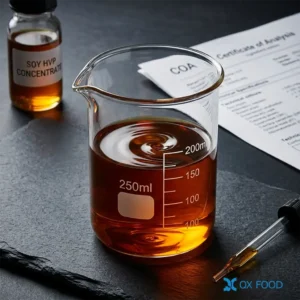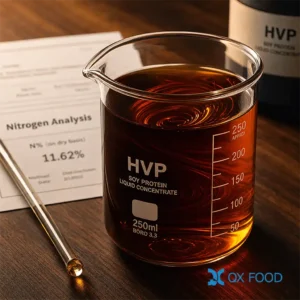
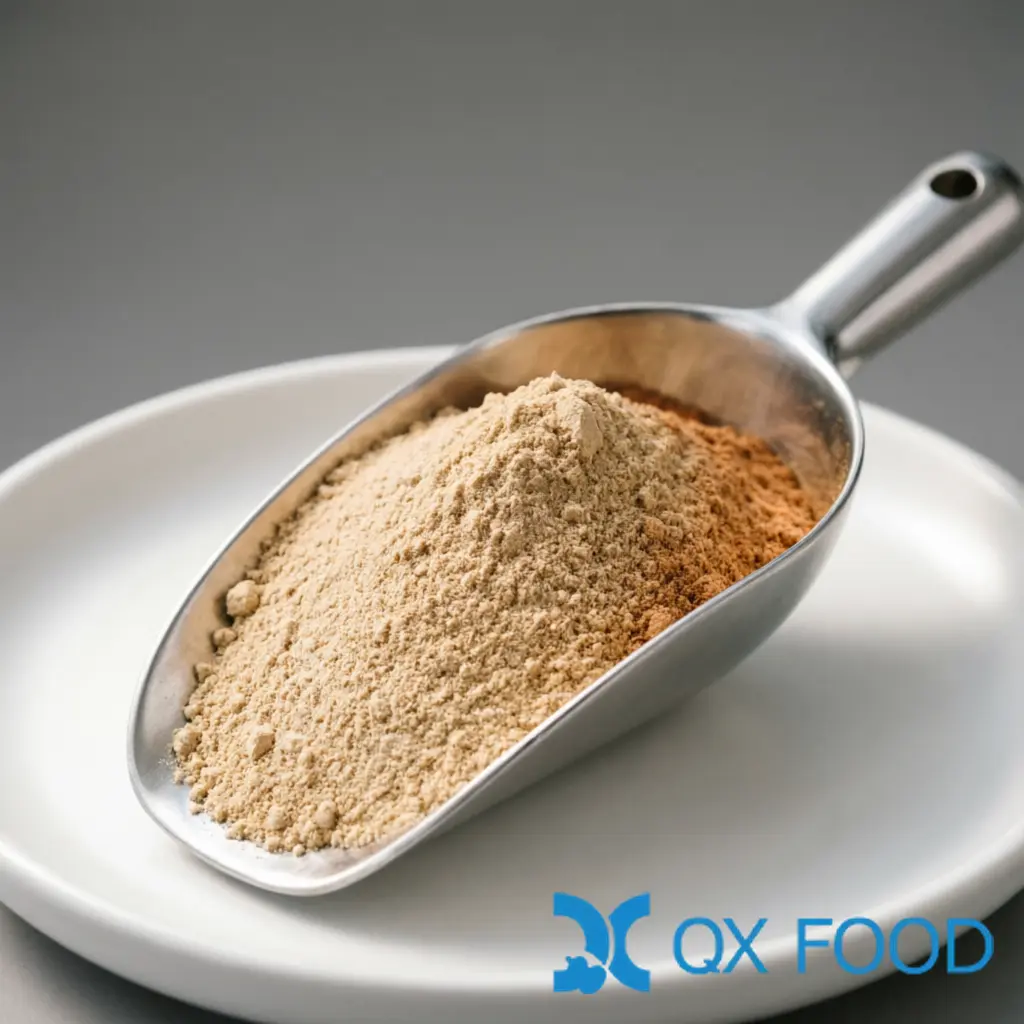
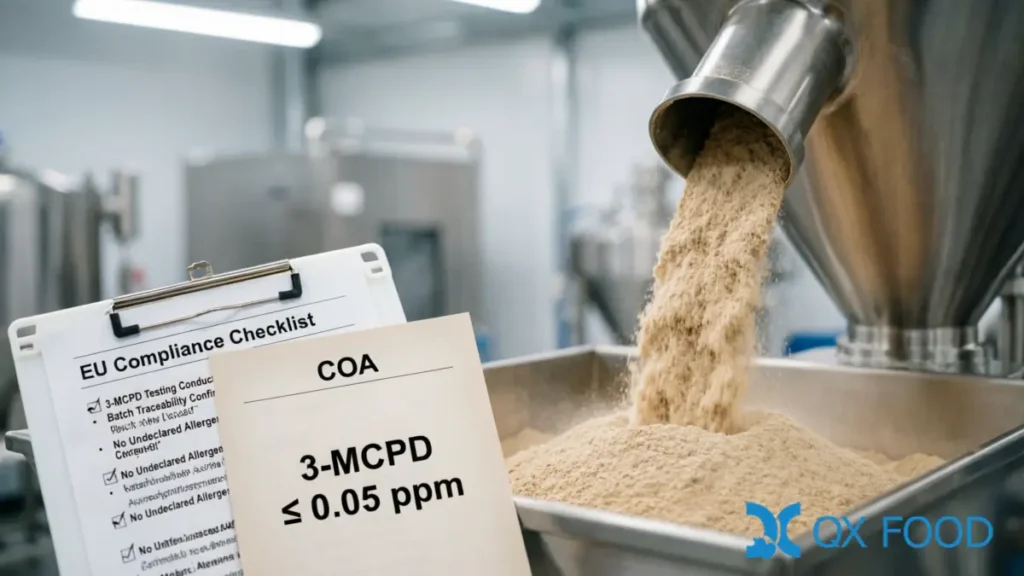
Light color soy HVP powder HVP-FSB occupies a unique position in the Qianxuan powder HVP portfolio — it delivers premium nitrogen density (total N 4.2 g/100g, actually exceeding the “high nitrogen” FSAH at 4.13) while maintaining a lighter-colored appearance and the lowest 3-MCPD measurement in the entire HVP range at ≤0.05 mg/kg. Spray-dried from soy protein through acid hydrolysis, this EU compliant HVP powder combines three attributes that typically do not appear together in a single product: high functional nitrogen, visually unobtrusive light color, and 3-MCPD levels that are 95% below the Codex ceiling — making it the preferred soy HVP powder for export-grade formulations targeting EU-regulated markets, light-colored seasoning blends where reddish-brown powder would darken the product, and applications where 3-MCPD documentation is a supplier qualification requirement. Its features explicitly note compliance with EU standards, and the 3-MCPD value of ≤0.05 mg/kg — measured at one-twentieth of the regulatory ceiling — is a genuine procurement differentiator for buyers whose quality systems flag 3-MCPD as a monitored parameter.
Three Attributes in One Product: Why FSB’s Combination Matters
Most HVP powders force a choice: high nitrogen means deeper color and higher salt from prolonged hydrolysis; low 3-MCPD means tighter process control that some manufacturers do not achieve at premium nitrogen levels; light color means the powder can be used in visually sensitive formulations. A light color soy HVP powder that delivers all three simultaneously — nitrogen at 4.2 g/100g, color visibly lighter than the typical brownish-red HVP powder, and 3-MCPD at ≤0.05 mg/kg — eliminates a procurement trade-off that many formulators accept as inevitable.
The practical implications of each attribute:
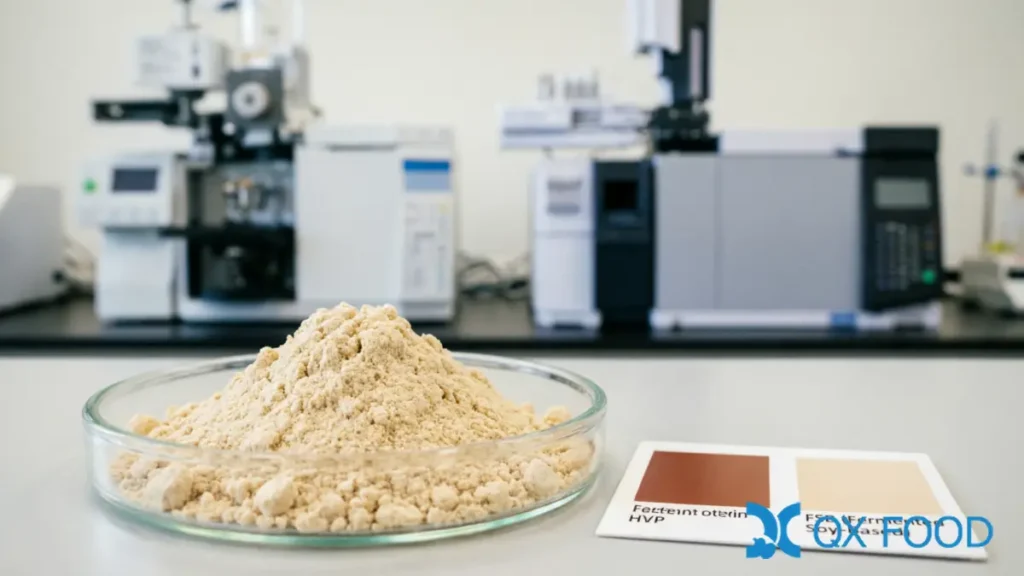
- Light color. Standard and premium HVP powders are brownish-red. This light colored hydrolyzed soy protein is visibly paler — closer to a light tan or pale brown. In cream-based soups, white sauce formulations, light-colored bouillon powders, delicately colored seasoning blends, and products where the visual identity depends on a clean off-white base, a dark HVP would introduce unwanted tinting that this light color soy HVP powder avoids. For a visual comparison with standard powder, see HVP-FSA.
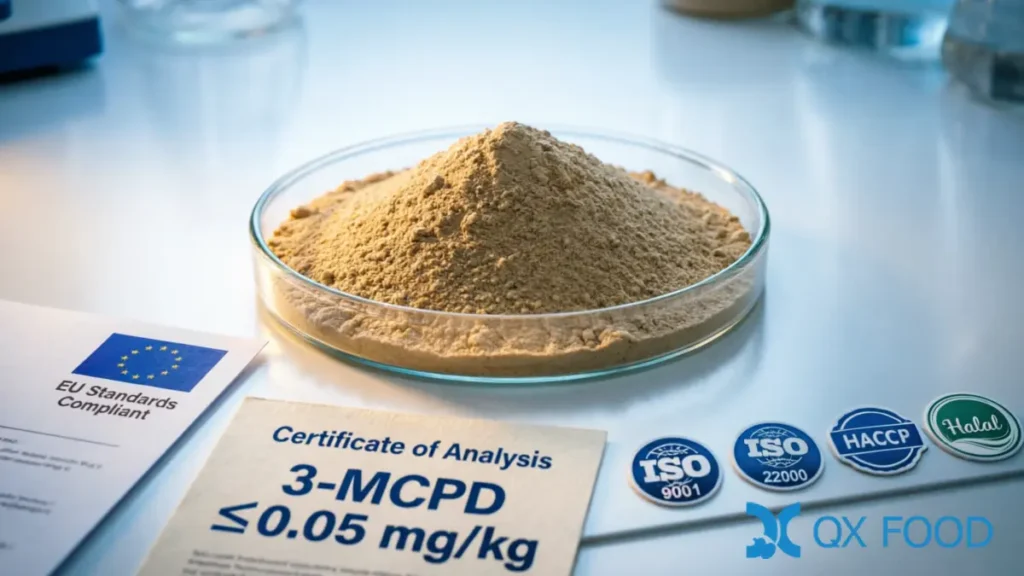
- EU compliance. The product features explicitly state compliance with EU standards. The 3-MCPD value of ≤0.05 mg/kg — measured per GB 5009.191 using the type inspection protocol — is one-twentieth of the Codex guideline (≤1.0 mg/kg) and well within the EFSA monitoring framework for acid-hydrolyzed vegetable protein under EU 1881/2006. For importers and distributors selling into EU member states, this EU compliant HVP powder simplifies the documentary burden of demonstrating contaminant control — a meaningful operational advantage in markets where 3-MCPD documentation is a non-negotiable part of supplier qualification.
- Total N 4.2. At 4.2 g/100g measured, this light color soy HVP powder delivers essentially the same nitrogen density as the premium high-nitrogen tier. This is not a nitrogen compromise for the sake of lighter color — it is a nitrogen-competitive product that happens to be lighter. The amino nitrogen at 3.0 g/100g provides abundant free amino acids for umami perception and Maillard browning at the standard 2-10% powder inclusion rate. Compare with the full HVP solutions guide for nitrogen-tier analysis across powder and liquid formats.
3-MCPD at ≤0.05 mg/kg: What This Means for Export Documentation
3-MCPD (3-monochloropropane-1,2-diol) is the most scrutinized contaminant in acid-hydrolyzed vegetable protein. The Codex Alimentarius guideline sets a ceiling of ≤1.0 mg/kg. Most HVP products in the Qianxuan range operate at ≤1.0 mg/kg, with some SKUs at ≤0.4 mg/kg — already conservative. This low 3-MCPD HVP powder at ≤0.05 mg/kg is in a different category: it is 95% below the regulatory ceiling and 87.5% below the ≤0.4 mg/kg tier that many liquid HVP products achieve as their low-MCPD benchmark.
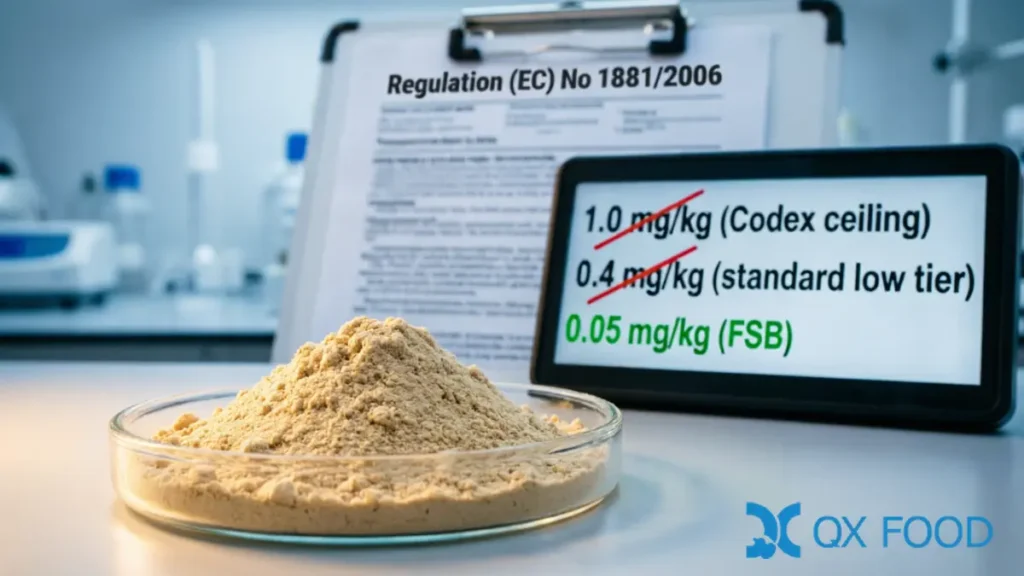
What this means operationally for a procurement manager: when submitting supplier documentation for a new ingredient in an EU-regulated product, the 3-MCPD value on the COA is one of the first numbers an importer’s quality team will check. A value of ≤0.05 mg/kg is self-evidently compliant — it requires no explanation, no risk assessment calculation, no mitigation narrative. It simply passes. This EU compliant HVP powder eliminates the most common documentation friction point in HVP procurement for EU-bound products. Combined with the ISO 9001, ISO 22000, HACCP, and Halal certifications confirmed at the manufacturing level, the quality documentation package for this product is among the strongest in the powder HVP range. For regulatory reference, see the full analysis of acid-HVP safety from EFSA and Codex Alimentarius.
Technical Specifications: Light Color EU-Compliant HVP Powder
| Parameter | Specification | Formulator’s Note |
|---|---|---|
| Product SKU | HVP-FSB | Light color + EU compliant + high nitrogen positioning |
| Physical State | Powder (~96% solids) | Free-flowing; dry blending, sachet filling, coating |
| Appearance | Light color — paler than standard brownish-red HVP | Suitable for cream soups, white sauces & light-colored blends |
| Flavor | Soybean protein flavor; typical amino acid flavor | Clean soy character without heavy roasted notes |
| Total Nitrogen | ≥4.0 g/100g (measured 4.2) | Competitive with premium FSAH (4.13) — light color with premium N |
| Amino Nitrogen | ≥2.80 g/100g (measured 3.0) | Abundant free amino acids for umami and Maillard |
| Sodium Chloride | ≤42.0 g/100g (measured 39) | Typical powder HVP salt; account for in sodium target |
| Moisture | ≤7.0 g/100g (measured 4.2) | Low moisture — good stability and flowability |
| 3-MCPD | ≤1.0 mg/kg COA; measured ≤0.05 | 95% below Codex ceiling — best-in-portfolio 3-MCPD |
| Certification | ISO 9001, ISO 22000, HACCP, Halal | All four in core specification |
| Process | Acid Hydrolysis + Spray Drying | Controlled hydrolysis for consistent amino acid profile |
| Suggested Usage | 2-10% of formulation | Calibrate for target umami, visual profile, and salt |
The defining trifecta of this light color soy HVP powder — total N 4.2 g/100g, light color, and 3-MCPD ≤0.05 mg/kg — creates a product profile that no other single SKU in the powder HVP range replicates. The FSAH at 4.13 N is brownish-red. The FSA at 3.2 N is brownish-red. The MF-01 at 2.3 N is deeply colored with rich bean aroma. FSB is the only powder HVP that combines premium nitrogen with light visual impact and best-in-class EU contaminant compliance. For buyers evaluating HVP powder across these three procurement criteria simultaneously — nitrogen performance, visual neutrality, and export documentation — this EU compliant HVP powder is the most efficient single-SKU answer. Full regulatory reference: Codex Alimentarius and EFSA.
Applications Where Light Color and EU Compliance Matter Most
① Clean-Label and Free-From Product Lines for EU Markets
The primary procurement use case. Food manufacturers developing clean-label soups, sauces, seasonings, and bouillon products for EU retail markets face two simultaneous requirements: the ingredient must deliver functional umami (which this light color soy HVP powder provides at 4.2 N), and the 3-MCPD documentation must satisfy EU importer quality standards (which the ≤0.05 mg/kg value simplifies). For brands positioning products with “free-from” or “clean ingredient” messaging — where any contaminant discussion during supplier qualification can delay market entry — this EU compliant HVP powder removes 3-MCPD as a documentation bottleneck entirely. Compare with HVP-FSA standard for applications where EU documentation is not the primary procurement driver.
② Light-Colored Seasoning Blends and Cream-Based Formulations
In cream of mushroom soup powder, white sauce bases, and delicately colored seasoning blends, a brownish-red HVP powder introduces visible dark specks or an overall brownish tint that may conflict with the product’s visual identity. This light colored hydrolyzed soy protein preserves the intended visual profile — lighter in appearance than standard HVP powder — while delivering the same 4.2 N functional performance. The visual difference is most noticeable in dry powder blends where the seasoning base color is expected to be off-white, cream, or pale yellow. For visually-sensitive applications requiring soy-free protein source, see HVP-FYA corn powder.
③ Instant Noodle and Soup Sachet Export Production
Instant noodle manufacturers exporting to the EU must demonstrate contaminant compliance across all sachet ingredients. The seasoning sachet typically contains salt, MSG, spice powders, and HVP — and the HVP is the ingredient most likely to be flagged for 3-MCPD review. Using this low 3-MCPD HVP powder at ≤0.05 mg/kg in the sachet formulation means the HVP contributes negligible 3-MCPD to the finished product — simplifying the total contaminant calculation for the entire sachet. The light color is an additional benefit: it does not darken the visual appearance of the dry powder mix inside the sachet, maintaining a clean, marketable appearance when the consumer opens the packet. For noodle seasoning applications at higher nitrogen intensity, refer to HVP-FSCH premium powder.
④ Meat Processing and Savory Emulsion Systems (2-10%)
In light-colored sausage and meatball formulations where visual neutrality matters alongside flavor performance, this light color soy HVP powder contributes 4.2 N of umami without the color contribution that a darker HVP would introduce. The EU compliance advantage applies here for processed meat products destined for EU retail channels — where 3-MCPD monitoring in processed meat ingredients is part of standard importer due diligence.
⑤ Foodservice and Catering Base Production for Export
Bulk seasoning bases, bouillon pastes, and foodservice flavor systems destined for EU-based foodservice operators benefit from the combined attributes of this soy HVP powder for export: competitive nitrogen (4.2 N), light visual impact, and EU-grade contaminant documentation. For foodservice product developers building seasoning systems that will be audited by EU-based clients, the COA documentation package for FSB — showing 3-MCPD ≤0.05 with ISO 9001/22000/HACCP/Halal certifications — represents a supplier qualification advantage over HVP products with higher MCPD values.
Why Export-Oriented B2B Buyers Choose FSB Over Standard HVP Powders
- 3-MCPD ≤0.05 mg/kg — best in portfolio. This low 3-MCPD HVP powder eliminates the most common regulatory friction point in HVP procurement for EU-bound products. 95% below Codex ceiling, 87.5% below the ≤0.4 tier. For importers whose quality systems require EFSA-referenced contaminant documentation, the ≤0.05 value is self-evidently compliant.
- Premium nitrogen with light color. Total N 4.2 g/100g — essentially tied with the premium high-nitrogen tier — in a lighter-colored powder that preserves the visual identity of light-colored finished products. No other powder HVP SKU combines nitrogen at this level with light visual impact.
- EU standards explicitly referenced. The product features state compliance with EU standards — not a generic “international standards” claim but an explicit EU compliance reference. For procurement managers whose qualification checklists include EU-specific compliance criteria, this EU compliant HVP powder provides a documented answer rather than requiring interpretation.
- Full certification suite. ISO 9001, ISO 22000, HACCP, Halal — all four confirmed in the core product specification. The Halal documentation supports procurement for halal-certified EU food production lines where both contaminant compliance and halal certification must be demonstrated simultaneously.
- Supply-chain ready. 100 g and 1 kg foil bags for trials, 10 kg and 20 kg cartons for production, 25 kg fiber drums for bulk. Custom packaging available. MOQ 1 MT, 1 kg samples. Contact us for EU-specific documentation packages and volume pricing.
Storage, Handling & Compliance
Powder Storage
- Store sealed below 25°C, humidity below 60%
- Reseal tightly — hygroscopic powder, caking risk in humid environments
- Shelf life: 12 months under recommended conditions
Compliance
ISO 9001, ISO 22000, HACCP, Halal certified. GB 2760 compliant. EU food safety standards per product features. 3-MCPD ≤0.05 mg/kg measured — verified per shipment via COA. Allergen: Soy protein — contains soybean allergens. For soy-free export alternatives, see corn HVP powder.
Frequently Asked Questions About Light Color EU-Compliant HVP Powder
What does “compliant with EU standards” mean for HVP powder procurement?
For this light color soy HVP powder, EU compliance centers on 3-MCPD contaminant control — measured at ≤0.05 mg/kg, the lowest in the powder HVP portfolio and 95% below the Codex guideline of ≤1.0 mg/kg. EU 1881/2006 establishes maximum levels for certain contaminants in foodstuffs, and while 3-MCPD limits for HVP are primarily Codex-referenced rather than having a specific EU MRL, importers and food manufacturers routinely apply Codex guidelines as their 3-MCPD benchmark. A value of ≤0.05 mg/kg not only passes the Codex ceiling — it exceeds the ≤0.4 mg/kg threshold that many premium HVP products target as their low-MCPD standard — making documentation submission for EU-bound products straightforward and reducing the risk of additional testing or certification requests during the import clearance process.
Source: EFSA Panel on Contaminants in the Food Chain (CONTAM) — Scientific opinion on 3-MCPD in hydrolyzed vegetable protein and soy sauce.
Can light-color HVP powder be used in clear soup and cream-based applications?
Yes. Standard HVP powder is brownish-red and visibly darkens light-colored formulations — cream of mushroom soup powder, white sauce bases, bechamel-style seasoning mixes, and delicately colored bouillon blends. This light colored hydrolyzed soy protein at 4.2 N preserves the intended visual profile of the finished product while delivering the same functional nitrogen contribution. For dry powder blends where the base color is off-white or cream, the visual difference between brownish-red standard HVP and light-color FSB is immediately visible in the dry mix — not just in the rehydrated product. Compare with HVP-FSA standard powder for cost-vs-color trade-off analysis.
How does the nitrogen level of FSB compare to premium high-nitrogen HVP?
This light color soy HVP powder delivers total N 4.2 g/100g measured — competitive with the premium high-nitrogen tier (HVP-FSAH at 4.13 g/100g). The amino nitrogen at 3.0 g/100g provides abundant free amino acids for umami perception and Maillard browning at standard 2-10% inclusion rates. The nitrogen advantage over standard powder HVP (FSA at 3.2 N, approximately 31% higher) means formulators achieve stronger savory impact at the same inclusion rate — or the same impact at a lower rate, reducing HVP volume and associated salt contribution. This makes FSB a nitrogen-competitive alternative to premium-tier powders, with the added advantages of lighter color and superior 3-MCPD documentation.
What is the 3-MCPD level and why does it matter for EU export?
The measured 3-MCPD value of this low 3-MCPD HVP powder is ≤0.05 mg/kg — 95% below the Codex Alimentarius guideline (≤1.0 mg/kg) and 87.5% below the ≤0.4 mg/kg tier that premium liquid HVP products target. For EU-bound food products using HVP as an ingredient, the importer’s quality assurance team will typically review the 3-MCPD COA value against Codex guidelines during the supplier qualification process. A value of ≤0.05 mg/kg eliminates 3-MCPD as a documentation risk point — no additional justification, risk assessment, or mitigation narrative is required. This is the strongest 3-MCPD documentation package available among Qianxuan powder HVP products.
Source: Codex Alimentarius — Code of Practice for the Reduction of 3-Monochloropropane-1,2-Diol (3-MCPD) during the Production of Acid-HVPs.
What is the shelf life and how should HVP powder be stored for export shipment?
Shelf life is 12 months under recommended conditions: sealed container, below 25°C, humidity below 60%. For ocean freight export shipping to EU ports — where transit times from China typically range 30-45 days — the 12-month shelf life provides ample buffer for shipping, customs clearance, and distribution. Standard packaging includes 20 kg cartons with PE inner liner bags; bulk shipment in 25 kg fiber drums is available. Moisture at 4.2 g/100g measured (well below the ≤7.0 g/100g standard) provides good stability against caking during maritime transit through humid environments, though proper container sealing and desiccant use during shipping are recommended as standard practice for any hygroscopic powder ingredient. Contact our logistics team for shipping specifications and packaging recommendations by destination port.
Does FSB carry Halal certification for EU halal food production lines?
Yes. Halal certification is confirmed in the core product specification for this EU compliant HVP powder — alongside ISO 9001, ISO 22000, and HACCP. For food manufacturers operating halal-certified production lines in EU member states (where halal certification is increasingly integrated into mainstream food manufacturing for both domestic and export markets), FSB provides both the contaminant documentation (3-MCPD ≤0.05 mg/kg) and the halal certification in a single ingredient package. Halal documentation is available per shipment to support your own product certification requirements.
What is the MOQ and sample policy for first-time EU import evaluation?
MOQ is 1 metric ton. 1 kg samples are available for qualified buyers — we provide the full COA package including 3-MCPD analysis and nitrogen/salt/moisture parameters with each sample, so your quality team can evaluate the documentation alongside the ingredient performance. This is particularly important for EU-bound product development where supplier qualification typically requires COA review before the first commercial order. For larger-volume EU procurement, contact our export team for FOB pricing, shipping documentation requirements by destination port, and multi-container volume discounts.
Explore Light Color, Premium, and EU-Compliant HVP Options
- HVP-FSA Standard Soy HVP Powder — Reference grade at 3.2 N, brownish-red
- HVP-FSAH High-Nitrogen Soy HVP Powder — Premium tier at 4.13 N
- HVP-FSCH Seasoning Grade HVP Powder — Alternative premium powder
- MF-01 Specialty Flavor HVP Powder — Rich bean aroma for flavor systems
- HVP-FYA Corn HVP Powder — Soy-free corn-based alternative
- HVP-FYC High-Nitrogen Corn Powder — Premium soy-free corn
- HVP-YBI Enhanced Umami Soy Liquid — Liquid format for aqueous systems
For the full product selection, visit the HVP product overview and complete HVP solutions guide. For EU documentation or light-color application support, contact our technical team.
Request a Sample or EU Export Quote
Ready to evaluate this light color soy HVP powder with 3-MCPD ≤0.05 mg/kg for your EU-bound formulation?
- Submit inquiry — Application, monthly volume, EU destination country, documentation requirements
- Receive spec sheet + COA with 3-MCPD analysis — Within 1 business day
- Request 1 kg sample — Full COA included for supplier qualification
- Confirm formulation fit — Technical team supports light-color visual assessment and EU documentation review
- Place production order — Competitive FOB; EU shipping documentation package available
Contact us today to start your evaluation.