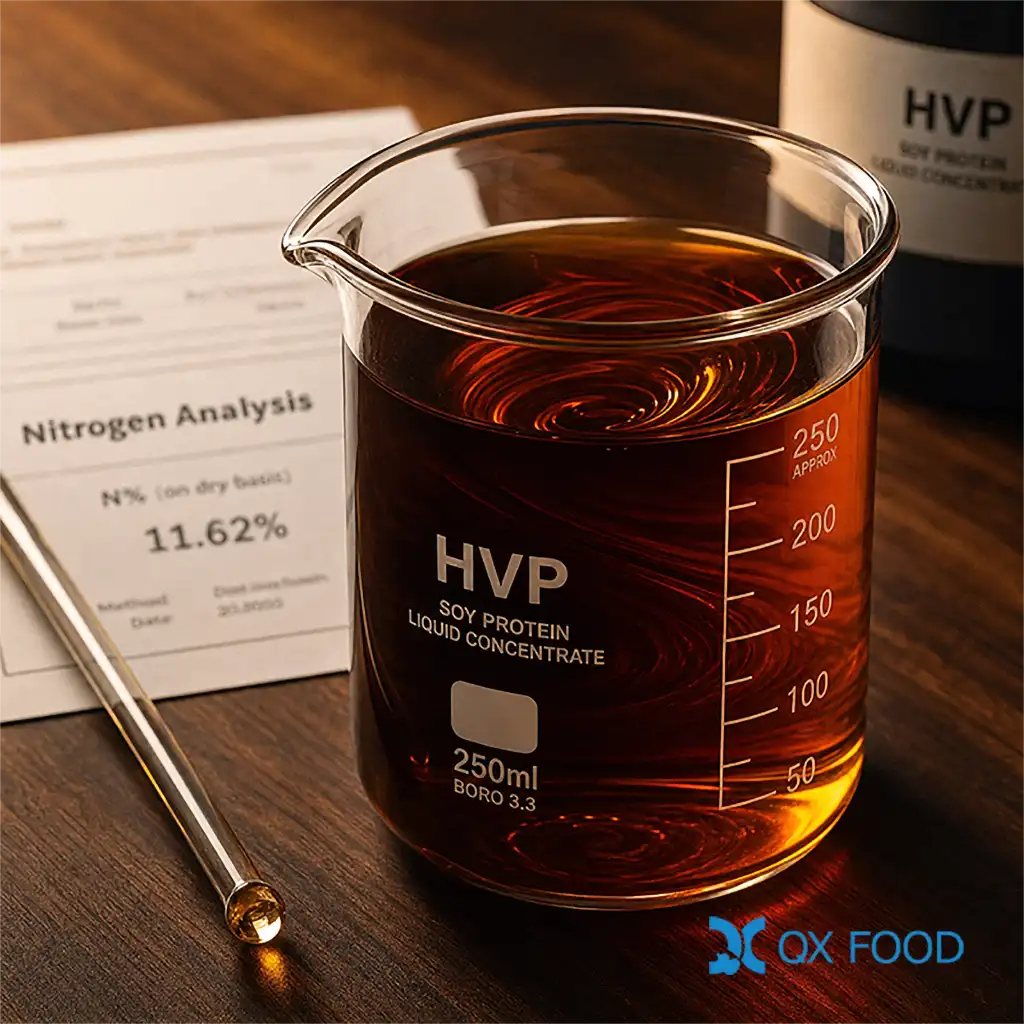
High nitrogen soy HVP liquid HVP-YSBH is the premium-tier acid-hydrolyzed vegetable protein liquid in the Qianxuan range, delivering the highest measured total nitrogen at 2.3 g/100g among liquid HVP SKUs. Designed for applications where maximum amino acid density matters — premium soy sauce production, professional meat processing, concentrated bouillon bases, and plant-based meat flavor systems — this premium soy HVP liquid provides up to 18% more nitrogen per unit than standard-grade alternatives. Its sensory profile matches the classic soy HVP character: rich sauce fragrance, light and pure ester top note, brownish-red to light yellow appearance, clear and transparent. Produced under ISO 9001, ISO 22000, HACCP, and Halal certified systems with 3-MCPD ≤0.4 mg/kg.
Why High Nitrogen Matters in Liquid HVP
Total nitrogen in HVP is a proxy for amino acid content — the raw material driving umami intensity, Maillard browning, and flavor depth. Every liquid HVP in the Qianxuan range delivers functional nitrogen, but high nitrogen soy HVP liquid like HVP-YSBH operates at a different tier. The measured value of 2.3 g/100g total nitrogen is the highest among all soy liquid HVP SKUs currently produced — approximately 15% above HVP-YBI enhanced umami (2.20 measured) and approximately 15% above HVP-YSB standard grade (2.0 measured).
What does 2.3 g/100g total nitrogen mean in the mixing tank? For a soy sauce manufacturer formulating at 15% HVP inclusion, switching from a 2.0 g/100g standard HVP to YSBH at 2.3 g/100g increases the amino acid contribution to the finished product by 15% at the same inclusion rate — or alternatively, allows the manufacturer to reduce the HVP inclusion rate while maintaining the same nitrogen target. For a factory producing 10,000 liters of soy sauce per batch, the cost-in-use calculation matters: the premium per kilogram of HVP-YSBH must be compared against the reduced volume needed, not against the per-kilogram price of standard HVP.
This is the essential economic logic for choosing a high N HVP liquid: not “is it more expensive per kilo?” but “does the increased nitrogen density deliver more umami at a lower total ingredient cost?” For premium soy sauce, professional bouillon concentrates, and high-end meat processing where flavor quality is the product’s competitive advantage, the answer is often yes.
Soy Sauce Production: The Nitrogen-Boosting Application
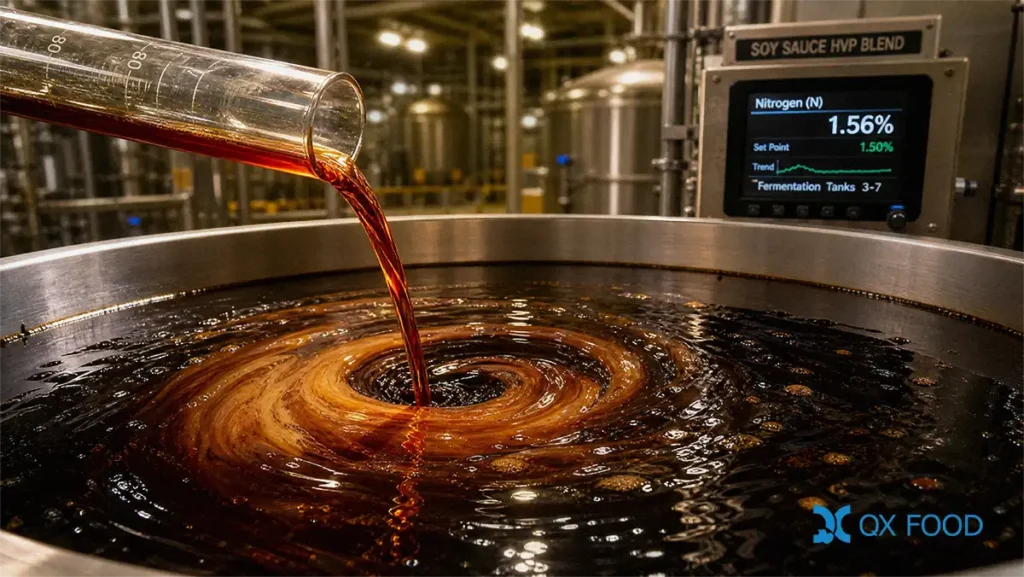
The most straightforward commercial case for HVP-YSBH is in premium soy sauce production. Traditional fermented soy sauce relies on months of koji fermentation to develop amino acids through enzymatic protein breakdown. Adding hydrolyzed soy protein liquid at the blending stage instantly increases the total nitrogen of the finished soy sauce — shortening the formulation cycle for manufacturers who need to hit specific nitrogen grade labels (e.g., “special grade” soy sauce standards in various markets) without extending fermentation time.
Because HVP-YSBH shares the same soy protein origin and similar sensory profile (rich sauce fragrance, ester top note) as fermented soy sauce, the HVP addition integrates without introducing foreign flavor notes. The clear, transparent appearance ensures the finished soy sauce retains its visual clarity — a turbid HVP would be immediately disqualifying for premium soy sauce applications where visual quality is part of the grading standard.
For soy sauce manufacturers comparing HVP nitrogen sources, also see the broader liquid HVP range and powder HVP for applications where dry blending is preferred.
Meat Processing: Flavor Stability and Juiciness
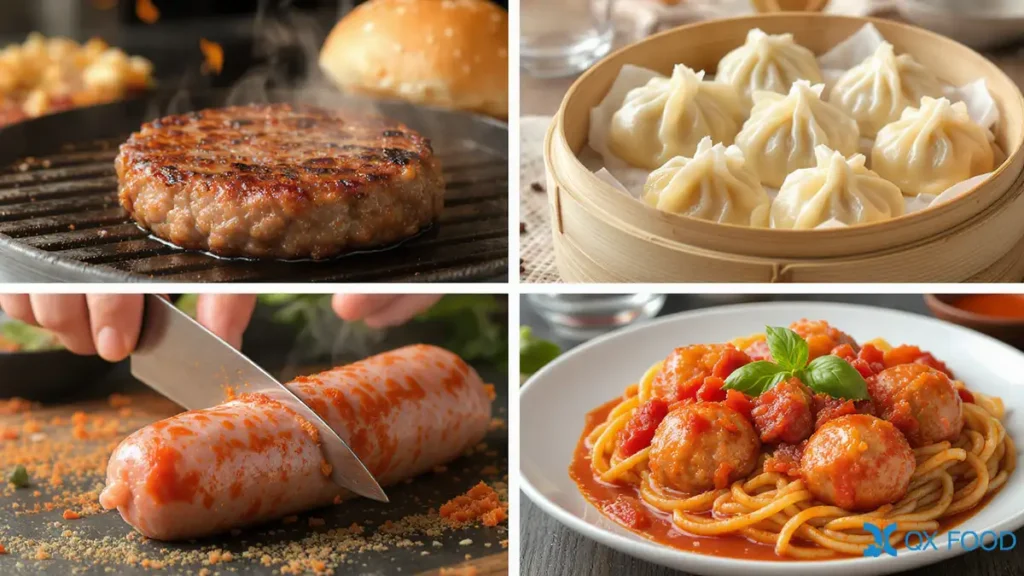
In sausage, ham, and marinated meat production, high nitrogen soy HVP liquid serves two functions simultaneously: flavor enhancement and water-binding contribution. The free amino acids from HVP contribute to the savory profile of the finished product, while the peptides and proteins participate in the meat emulsion, supporting texture and juiciness. The liquid format integrates directly into the meat emulsion during mixing — no pre-dissolution needed in what is already a wet processing environment.
HVP-YSBH’s rich sauce fragrance and mellow ester aroma also help mask off-notes from raw meat materials — liver notes in pâté, warmed-over flavor in pre-cooked products, and the metallic edge that can develop in cured meats during extended storage. This masking function is particularly relevant for export meat products with longer shelf-life requirements. Compare with mixed protein HVP liquid for alternative amino acid profiles in meat applications.
Plant-Based Meat: Masking “Beany” Off-Notes
This is an application where HVP-YSBH’s high nitrogen and rich ester aroma offer a specific, practical advantage. Plant-based meat formulations built on pea protein or soy protein isolate carry a characteristic “raw bean” or “earthy” note that consumer testing consistently identifies as a barrier to repeat purchase. Adding high nitrogen soy HVP liquid to these formulations contributes two effects: the free amino acids boost overall umami (making the product taste more “meaty”), and the rich sauce fragrance with ester top notes actively masks the beany off-notes by introducing a savory-dominant aroma layer that draws sensory attention away from the underlying plant protein character.
Unlike synthetic flavor masking agents or MSG-based approaches, HVP-YSBH is an ingredient — it appears on the label as “hydrolyzed soy protein,” which aligns with clean-label targets better than artificial flavor compounds. The liquid format integrates directly into the wet-mix stage of plant-based meat production without the dissolution bottleneck that powder HVP would create during high-moisture extrusion or emulsion mixing.
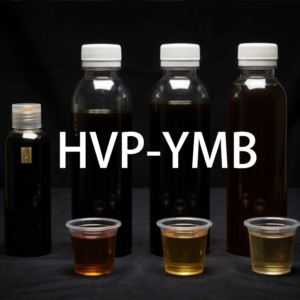
For plant-based formulations seeking a broader amino acid profile, HVP-YMB high-nitrogen mixed protein liquid offers complementary amino acids from multiple vegetable protein sources.
Technical Specifications: High Nitrogen HVP Liquid
| Parameter | Specification | What Matters for Formulators |
|---|---|---|
| Product SKU | HVP-YSBH | High-nitrogen tier — elevated specification position |
| Physical State | Liquid | Pumpable; no dissolution step |
| Appearance | Clear and transparent; brownish-red or light yellow | Visual clarity for premium soy sauce and clear broths |
| Total Nitrogen | ≥2.0 g/100g (standard) | 2.3 g/100g (measured) | Highest measured among liquid soy HVP — highest nitrogen figure in the liquid soy range |
| Sodium Chloride | ≤25.0 g/100g (standard) | 23.0 g/100g (measured) | Moderate salt — lower than powder HVP (40-50%) |
| 3-MCPD | ≤0.4 mg/kg (product notes) | Well below Codex ceiling of ≤1.0 mg/kg |
| Flavor | Soybean hydrolyzed protein flavor; rich sauce fragrance with light ester note | Integrates with fermented soy sauce; masks beany/earthy off-notes in plant protein |
| Protein Source | Soy Protein | Contains soybean allergens |
| Process | Acid Hydrolysis | Controlled hydrolysis for consistent amino acid profile |
| Suggested Usage | Compound seasonings 5–20%, pickled vegetables 10–40%, Maillard 5–20%, general seasonings 5–10%, vinegar 2–10% | Application-specific rates per product specification |
Reading the data note: The COA for HVP-YSBH includes total nitrogen and sodium chloride as the primary specification parameters. The amino nitrogen and solids content referenced in marketing descriptions are not part of the routine COA — we recommend requesting the full product specification sheet for the most current batch-level data when formulating. The 3-MCPD value of ≤0.4 mg/kg is per product notes and aligns with Codex Alimentarius and EFSA requirements for acid-hydrolyzed vegetable protein. Additional certification documentation including ISO 9001, ISO 22000, HACCP, and Halal is available per shipment.
Where HVP-YSBH Fits in the Liquid HVP Range
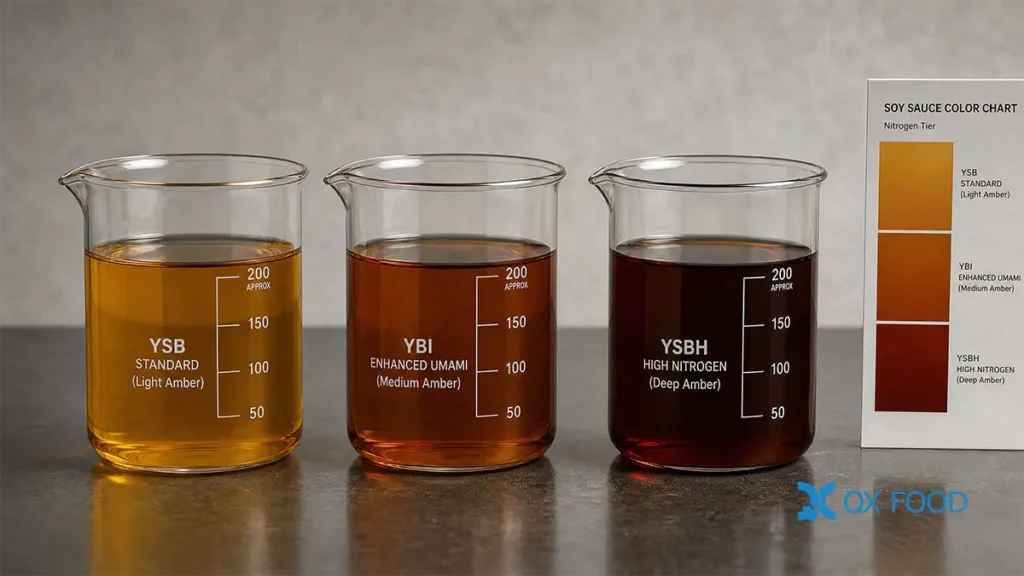
HVP-YSBH is not the default choice — it is the premium choice. Here is how the three soy liquid HVP tiers relate to each other:
- HVP-YSB (Standard) — Total N 2.0 measured. The workhorse for cost-effective sauce, seasoning, and soup production where the HVP supports other flavor ingredients. Choose when HVP is one ingredient among many.
- HVP-YBI (Enhanced Umami) — Total N 2.20 measured. Higher umami intensity for formulations where the HVP leads the flavor system. Choose when sensory impact is the priority.
- HVP-YSBH (High Nitrogen) — This product. Total N 2.3 measured — the highest in the range. Maximum amino acid density for premium soy sauce, professional meat processing, concentrated bouillon, and plant-based meat flavor systems. Choose when nitrogen per unit matters most — either for hitting premium product specifications or for maximizing cost-in-use efficiency at reduced inclusion rates.
The 15% nitrogen advantage of YSBH over YSB at the same inclusion rate translates differently depending on the application: in soy sauce production, it means hitting premium nitrogen labels faster; in plant-based meat, it means more umami per gram of HVP to mask off-notes; in concentrated bouillon, it means a richer flavor base with less volume. This is not a universal advantage — for standard compounding where HVP plays a supporting role, the nitrogen premium of YSBH may not justify the cost premium. For applications where nitrogen density is the formulation constraint, it does.
Storage, Handling & Compliance
Storage
- Sealed containers below 25°C, humidity below 60%
- Avoid direct sunlight
- Keep sealed — liquid HVP is hygroscopic in concentrate form
- Agitate gently before use after extended storage
- Shelf life: 12 months under recommended conditions
Compliance
Produced under ISO 9001, ISO 22000, HACCP, and Halal certified systems. Complies with GB 2760. Aligned with FAO/WHO Codex Alimentarius. 3-MCPD ≤0.4 mg/kg. COA and Halal documentation available per shipment. Allergen note: Soy protein source — contains soybean allergens. For soy-free alternatives, see corn-based HVP liquid.
Frequently Asked Questions
How does HVP-YSBH compare to HVP-YSB and HVP-YBI?
YSBH is the high nitrogen soy HVP liquid with total N measured at 2.3 g/100g — the highest in the range. YSB is the standard tier at 2.0 g/100g measured. YBI is the enhanced umami tier at 2.20 g/100g measured. Choose YSBH when nitrogen density is the formulation constraint — for premium soy sauce, meat processing, and plant-based applications where maximum amino acid contribution matters. Choose YSB for cost-effective standard applications. Choose YBI when enhanced umami character is the priority.
Why would I pay more for high nitrogen HVP?
The value proposition is cost-in-use, not per-kilogram price. Because YSBH delivers 15% more nitrogen per gram than standard HVP, formulators can either achieve a higher nitrogen target at the same inclusion rate, or maintain the target at a reduced inclusion rate — reducing the volume of HVP purchased. The premium price must be compared against the reduced volume needed, not against standard HVP per-kilo pricing.
Can HVP-YSBH mask plant-based protein off-notes?
Yes. The rich sauce fragrance and light ester top note of this premium soy HVP liquid actively mask the “raw bean” and “earthy” off-notes common in pea and soy protein isolates used in plant-based meat formulations. The high nitrogen content also contributes additional umami, making the product taste more “meaty” overall. This is one of the most commercially relevant applications for high-nitrogen HVP in the current plant-based protein market.
What is the nitrogen level and how is it measured?
Total nitrogen ≥2.0 g/100g standard, measured at 2.3 g/100g per GB 5009.5 (Kjeldahl method). This is the highest measured total nitrogen among Qianxuan liquid soy HVP SKUs. Batch-specific COA values are available upon request.
What is the salt content?
Sodium chloride ≤25.0 g/100g standard, measured at 23.0 g/100g per GB 5009.44. This is moderate for liquid HVP and lower than powder HVP (typically 40-50 g/100g). Formulators using YSBH should account for this salt contribution in the total formulation sodium balance.
What certifications apply and what documentation is available?
ISO 9001, ISO 22000, HACCP, and Halal — all four confirmed in the core specification. COA provided per shipment with total nitrogen and sodium chloride values. 3-MCPD ≤0.4 mg/kg per product notes, compliant with EFSA and Codex standards. Halal documentation available for qualified buyers.
What packaging and MOQ apply?
100 g and 1 kg aluminum foil bags for sampling, 10 kg and 20 kg cartons for production, 25 kg fiber drums for bulk. Custom packaging on request. MOQ 1 MT. 1 kg samples for qualified buyers. Contact us for specifics.
Explore Related HVP Products
HVP-YSBH is the high-nitrogen liquid HVP in the range. For other tiers, formats, or protein sources:
- HVP-YSB Standard Soy HVP Liquid — Standard tier for cost-effective production
- HVP-YBI Enhanced Umami HVP Liquid — Higher umami character for flavor-led applications
- HVP-YSA Soy HVP Liquid — Alternative standard soy liquid grade
- HVP-YSD Economical Soy HVP Liquid — Cost-focused economy tier
- HVP-YMA Mixed Protein HVP Liquid — Broader amino acid profile from blended protein sources
- HVP-YMB High-Nitrogen Mixed Liquid — Premium mixed protein high-N variant
- HVP-YYA Corn HVP Liquid — Soy-free corn-based alternative
- HVP-FSA Soy HVP Powder — Powder format when dry blending is required
- HVP-FSCH High-Nitrogen Soy HVP Powder — Premium high-N in powder format
- HVP-FSC Seasoning Grade HVP Powder — Standard seasoning-grade powder
For the full range, visit the HVP product overview and complete HVP solutions guide. For format comparison between powder and liquid, contact our technical team.
Request a Sample or Get a Quote
Ready to evaluate HVP-YSBH high nitrogen soy HVP liquid for your premium application?
- Submit inquiry — Target application, required volume, destination country
- Receive product specification sheet + COA — Within 1 business day
- Request sample — 1 kg trial samples for qualified buyers
- Confirm formulation fit — Technical team supports nitrogen density calculations and dosage calibration
- Place production order — Flexible packaging; competitive FOB pricing
Contact us today to start your product evaluation process.